


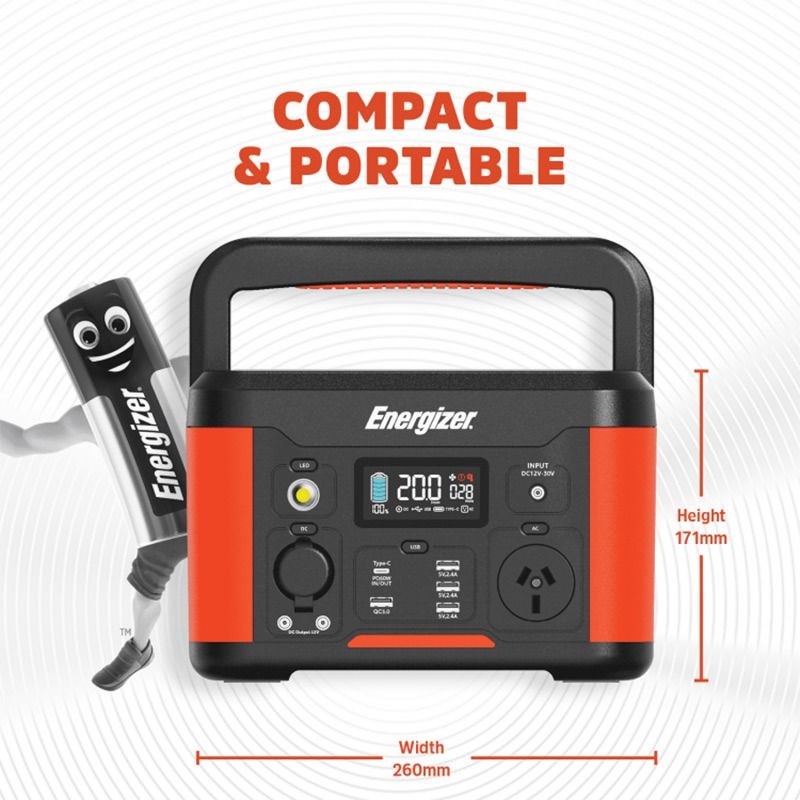
Power, unpacked
- ⚡ Tough & durable
- ⚡ Advanced battery management
- ⚡ Charge via solar panel
- ⚡ Multi-function LCD screen & flashlight
- ⚡ AC outlet
What 515Wh actually gets you
This is the size most people should buy, and the reason is a fridge. A 40L 12V compressor fridge draws 45W to 55W while the compressor runs, but it does not run constantly — it cycles, typically 35% to 50% of the time in Australian summer conditions, which averages out closer to 25W over a day. Against roughly 440Wh usable at the AC outlet, that is 17 to 19 hours: a night with room to spare, not a night that finishes at 4am. Add phones and lights and you are still comfortably through to morning.
Run times, with the maths shown
All figures below assume 515Wh at about 85% inverter efficiency, so roughly 440Wh at the outlet. CPAP with the humidifier off at 30-40W: 11 to 14 hours. CPAP with the humidifier on at 60-90W: 5 to 7 hours, so turn it off if you want the full night. Laptop at 45-65W: 7 to 10 hours. Portable fan at 20-40W: 11 to 22 hours. A 32-inch 12V TV at about 40W: 11 hours. Phone charges at about 15Wh each: 25 to 30 of them. Kettle, toaster or hair dryer: will not run at all, they are past the 500W inverter.
Pure sine wave and 12 outlets
The 500W output is a true pure sine wave at 230V/50Hz, which is what makes it safe for a CPAP machine or a fridge compressor rather than merely possible. There are twelve outlets in total — 1 AC, 3 DC, 4 USB-A and a 60W USB-C PD — so a family is not queuing for ports. That USB-C port will charge a modern laptop directly, which is worth doing: going straight to USB-C skips the inverter and its 15% loss, so you get meaningfully more out of the same battery.
Recharging it
The DC input accepts 19V/3.78A, about 72W, and the USB-C port takes 60W PD. From flat that works out near 7 hours on paper, and 8 to 9 is realistic once the taper is accounted for. Off-grid, the Sunpack 80W folding panel is the companion piece: in decent Australian sun expect it to return roughly 250-400Wh over a good day, which slows the drain substantially and can stretch a two-night trip into three or four. It will not hold the battery level against a fridge on a 38-degree day — one panel is a top-up, not a mains substitute.
The honest trade-off
Lithium-ion (NMC) cells, 24-month Australian warranty. Competitors at a higher price now use LiFePO4, rated for roughly 3,000 charge cycles against 500-800 here, and better in heat. At 5.6kg the 500 is genuinely carryable, which the 11kg Everest 1100 is not. Buy this one for capacity-per-dollar today and for a brand with local warranty and a phone number to call; buy LiFePO4 if maximum cycle life over many years is the priority.
What can it power?
- Mobile devices: 43 charges*
- Television: 48 charges*
- Laptops: 8 charges*
- Mini cooler: 7.5 hours*
*Approximate figures — actual results vary with device and conditions.
Specifications
| Size | 260 x 172 x 171mm |
|---|---|
| Weight | 5.6kg |
| Capacity | 515Wh (34.8Ah, 14.8V) |
| AC Output | 230V/50Hz, pure sine wave. 500W max |
| DC Output | 1 x DC auto outlet 12V/10A · 2 x DC 5.5mm port 12V/5A |
| USB-A Output | USB 1: QC 3.0 18W · USB 2–4: 5V/2.4A |
| USB-C Output | PD 60W (5V/9V/12V/15V/20V ⎓3A) |
| Input | DC port 19V/3.78A · USB-C PD 60W |
| Material | ABS plastic and polycarbonate |
What's in the box
- 1 x Everest 500 Portable Power Station
- 1 x Charging cable (AC/DC)
- 1 x User manual
Additional information
| Condition | New |
|---|---|
| Release date | 9th January 2023 |
| Weight (kg) | 6.70 |
| Item Code | 196077 |
| Product Type | Batteries |
| Barcode | 9359125000237 |
| Manufacturer | Energizer |
| Connectivity / Sockets | USB, USB-C |
You may also like
-
-
Jonah Lomu Rugby Challenge 4
Nintendo SwitchRegular price $49.95Sale price $49.95 Regular price$69.95 -
Aussie Rules Evolution 2
Nintendo SwitchRegular price $49.95Sale price $49.95 Regular price$69.95 -
Jonah Lomu Rugby Challenge 4 Remastered (PS5)
PlayStation 5Native 4K / 60fpsAvailable NowRegular price $59.95Sale price $59.95 Regular price


