


Power, unpacked
- ⚡ Market-leading 23% efficiency
- ⚡ Latest PD fast charging
- ⚡ 3-way charging (USB-A / USB-C / DC)
- ⚡ Foldable & weather-resistant
- ⚡ Clean renewable power
What 80W really delivers in Australian sun
A panel rated at 80W does not produce 80W for a day. Angle, temperature, haze and time of day mean 60-70% of the rated figure is a realistic average — call it 50-55W across a good day, over roughly five peak-sun-hours in an Australian summer, and fewer in Victoria or Tasmania in July. In practice that is about 250-400Wh returned per day. Useful, honest numbers to plan a trip around, rather than the number printed on the box.
The bottleneck is usually the power station, not the panel
The Sunpack outputs up to 18V/4.5A, about 81W, but each Everest limits how fast it will accept a DC charge. The Everest 300 caps at 45W, so the panel cannot deliver its full output into it. The Everest 500 accepts about 72W, which is close to the panel's ceiling and the best-matched pairing of the range. For the Everest 1100, whose DC input is specified at 24V against this panel's 18V, contact us before pairing them — we would rather confirm than have you find out in a paddock.
What it means for a real trip
One Sunpack 80W is a top-up panel, not a fast charger. Paired with an Everest 500 running a 12V fridge — roughly 400-700Wh a day depending on heat — a single panel returns enough to slow the drain substantially and turn a two-night trip into three or four. It will not hold the battery level indefinitely against a fridge in summer. For genuinely open-ended off-grid running, plan on two panels or a larger one, and size the battery for the worst night rather than the average one.
Getting the most out of it
Aim the panel at the sun and re-aim it three or four times a day. A panel lying flat on the ground can lose 30-40% against one angled correctly, and this matters more than anything else on this list. Keep it clear of shade — even a thin shadow across a single cell drags the whole panel's output down. Start early, because output falls away sharply after mid-afternoon. And avoid running the power station while charging it if you can: filling and draining at once wastes a day of sun.
Built to be moved
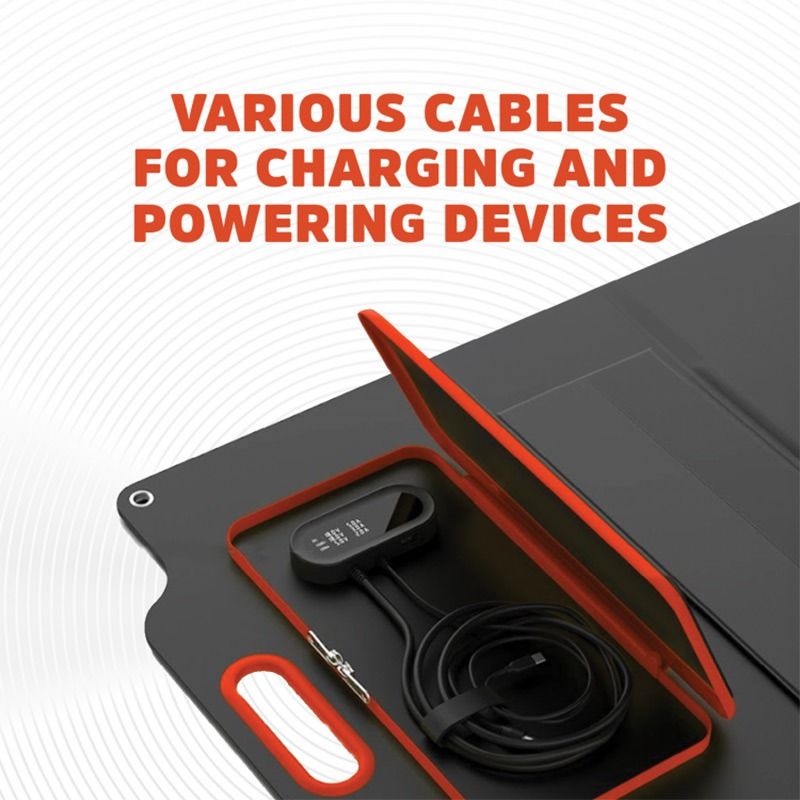
23% cell efficiency, folded to 590 x 525 x 30mm and 3kg, with USB-A, USB-C and DC leads built in so it charges phones and laptops directly without a power station in the middle. Rated for -10°C to 60°C operating temperature. Unfolded it is 1185mm across, so allow a clear patch of ground or a car roof to lay it out properly.
What can it power?
- Phones & tablets
- Laptops
- Music speakers
- Everest power stations
*Approximate figures — actual results vary with device and conditions.
Specifications
| Peak Power | 80W |
|---|---|
| Cell Efficiency | 23% |
| Power Voltage | 18V |
| Power Current | 4.5A |
| Open Circuit Voltage | 21.6V |
| USB-A Output | 5V/2.4A |
| USB-C Cable Output | 5V/2.4A |
| DC Cable Output | 18V/4.5A |
| Operating Temperature | -10°C to 60°C |
| Dimensions (unfolded) | 1185 x 525 x 7mm |
| Dimensions (folded) | 590 x 525 x 30mm |
| Weight | 3kg |
What's in the box
- 1 x Foldable solar panel with 2 x built-in charging cables (USB-C/DC)
- 1 x User manual
Additional information
| Condition | New |
|---|---|
| Release date | 9th January 2023 |
| Weight (kg) | 5.13 |
| Item Code | 196080 |
| Product Type | Solar Panels |
| Barcode | 9359125000350 |
| Manufacturer | Energizer |
You may also like
-
-
Jonah Lomu Rugby Challenge 4
Nintendo SwitchRegular price $49.95Sale price $49.95 Regular price$69.95 -
Aussie Rules Evolution 2
Nintendo SwitchRegular price $49.95Sale price $49.95 Regular price$69.95 -
Jonah Lomu Rugby Challenge 4 Remastered (PS5)
PlayStation 5Native 4K / 60fpsAvailable NowRegular price $59.95Sale price $59.95 Regular price


